Modelo 036 in English: what it is, who files it and how
Modelo 036 is the census declaration of the Agencia Tributaria, Spain's tax agency. You file it to register as a business or professional before you start, to report any change in your details, and to deregister when you stop. Filing is free, online or on paper.
 Deadlines, boxes and worked examples, each fact with its official source.
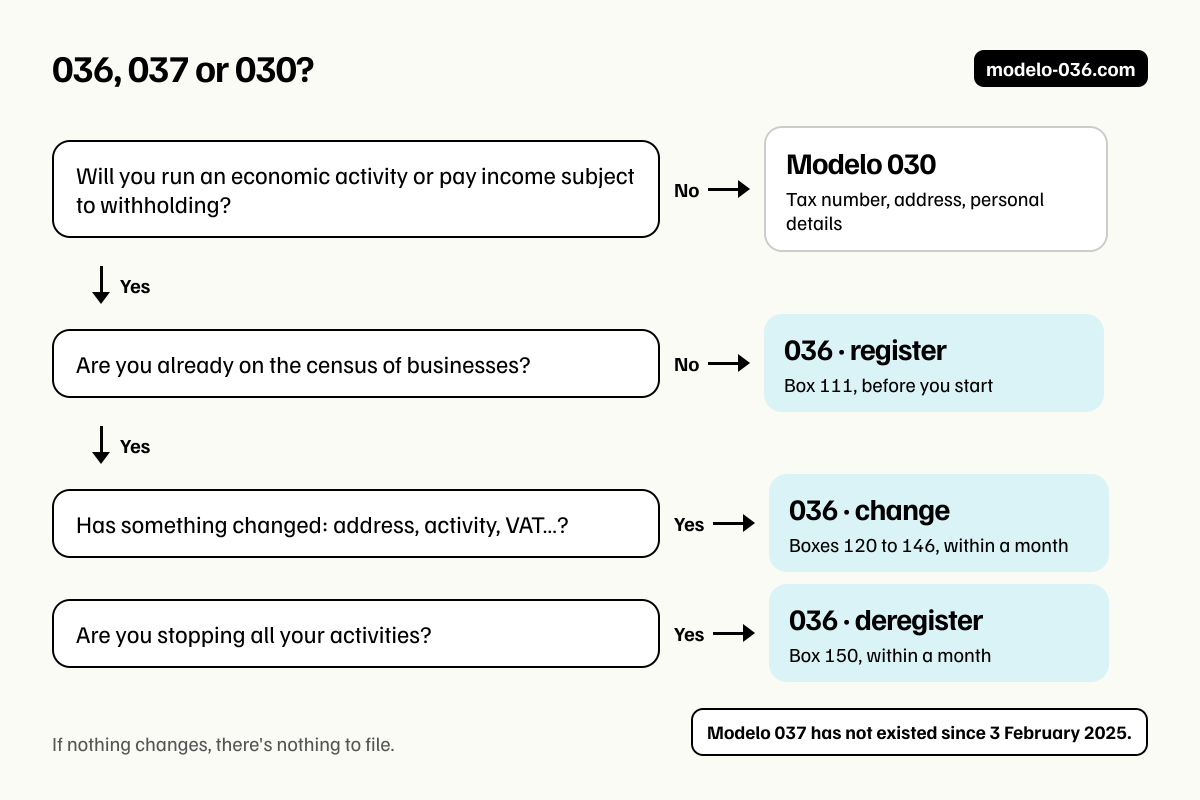
- Modelo 037 no longer exists: since 3 February 2025, everything goes through the 036.
- Holiday lets: from 1 December 2026 they pay VAT, and their owners must register.


What is Modelo 036?
Modelo 036 is the declaración censal: the form that puts you on, updates and takes you off the Agencia Tributaria's census of businesses, professionals and withholders (Censo de Empresarios, Profesionales y Retenedores). You report the start of an activity, every later change and the end. Filing it is free, online or on paper.
Through the 036, the tax agency learns who you are, where your tax address is, what you do and which taxes concern you: it is where you choose your VAT scheme or your income-tax method, and it sets the periodic returns the agency will expect from you. The duty comes from the fifth additional provision of the General Tax Law; articles 9 to 11 of Royal Decree 1065/2007 regulate it, and Orden EHA/1274/2007 approves the form.
Registration, changes and deregistration: the three uses
- 1Registration (alta), box 111: before you start a business or professional activity, or pay income subject to withholding; a company also uses the 036 to get its tax number (box 110).
- 2Changes (modificación), boxes 120 to 146: whenever something you declared changes, such as your tax address, your activity, your VAT details or your entry in the intra-EU operators register.
- 3Deregistration (baja), box 150: when you stop all your activities or no longer need to be on the census.
036, 030, IAE and Social Security: what each one is
| Procedure | What it does | Filed with |
|---|---|---|
| Modelo 036 | Registering with, updating and leaving the census of businesses, professionals and withholders; for companies, also getting the tax number. | Agencia Tributaria |
| Modelo 030 | Individuals with no economic activity: joining the general taxpayer census, changing address or personal details. | Agencia Tributaria |
| Modelo 037 | Abolished on 3 February 2025: its simplified version now lives inside the 036. | No longer filed |
| Modelo 840 | Registering for the business activities tax (IAE) for those not exempt. Individuals are always exempt, and their 036 counts as their IAE declaration. | Agencia Tributaria (or the town hall or provincial council where IAE census management is delegated) |
| RETA registration | Registering as a self-employed worker with Social Security. The 036 doesn't do it. | Tesorería General de la Seguridad Social |
Sources: Orden EHA/1274/2007 (modelo 036) · Ley 58/2003 General Tributaria, disp. adicional 5.ª · Real Decreto 1065/2007, arts. 9 a 11 y 14 · Agencia Tributaria, modelo 036
Who has to file Modelo 036?
Everyone who belongs on the census of businesses, professionals and withholders: the self-employed and professionals before they start, companies and other entities (which also get their tax number this way), anyone paying income subject to withholding and, from 1 December 2026, the owner of a holiday let who must charge VAT.
- The self-employed (autónomos) and professionals about to start one or more activities in Spain.
- Companies and other entities: the 036 is also how they request their tax number (NIF), provisional and then definitive.
- Anyone paying income subject to withholding (salaries, professionals' invoices, the rent of business premises), even if they aren't in business.
- Partners, heirs and co-owners of pass-through entities (régimen de atribución de rentas), such as a co-ownership (comunidad de bienes) that runs an activity.
- Non-residents operating in Spain through a permanent establishment or paying income subject to withholding, and anyone not established in Spain who is liable for Spanish VAT.
- Landlords of business premises: letting property is a business activity for VAT.
Someone who only lets VAT-exempt property, such as a home the tenant lives in, isn't on the census (article 3.2 of the tax-management regulation) and doesn't file the 036, unless they pay income subject to withholding. That changes on 1 December 2026 for short lets: holiday-let owners who now charge VAT must file the 036.
Do you need to be autónomo? Modelo 036 is not Social Security
No. The 036 is a tax formality, with the Agencia Tributaria, and has no Social Security fields at all. Registering as a self-employed worker (RETA) is a separate procedure with the Tesorería General de la Seguridad Social: you apply before you start, at most 60 days ahead, and they ask for your IAE code. Only the single electronic document (DUE), filed through a business support point (Punto de Atención al Emprendedor), does both at once. A company, for example, files the 036 without joining the RETA.
Non-residents: NIE and tax representative
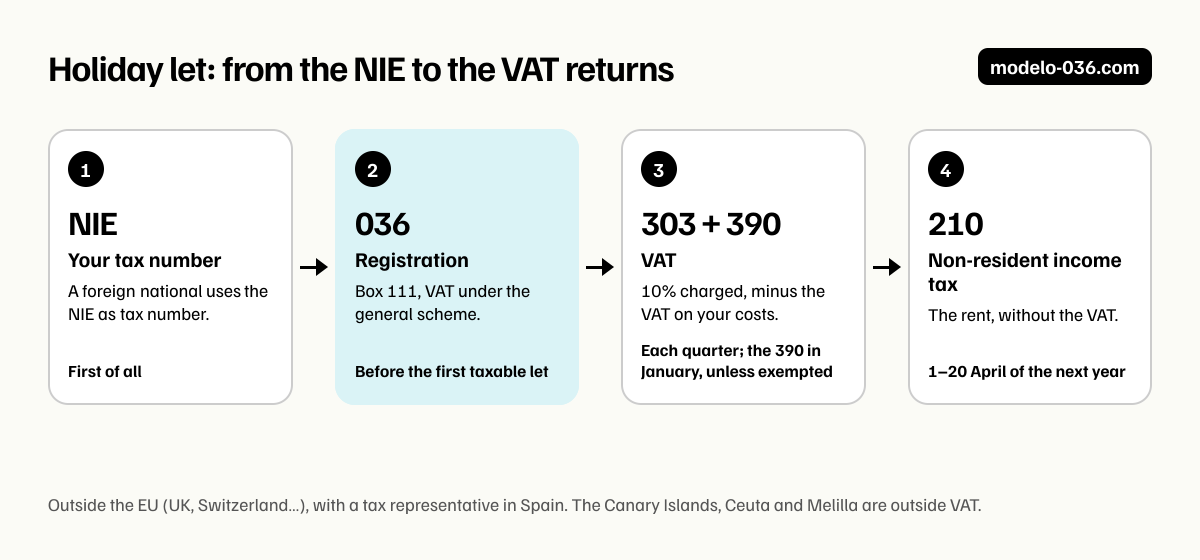
You need a Spanish tax identification number to file the 036: a foreign individual uses their NIE as their tax number (NIF) (without an NIE, they request one with box 110, on paper), and a foreign company requests its tax number with the 036 itself. A non-resident can't use Censos WEB or the simplified 036: they file the full 036.
For VAT, a business not established in the European Union must appoint a representative domiciled in Spain (article 164.Uno.7.º of the VAT Law), unless it is established in a State with mutual-assistance instruments: today, according to the Agencia Tributaria, only Norway. Owners living in the United Kingdom need one (ruling V0657-22), and so, on the same reading, do owners in Switzerland, which the Agencia Tributaria doesn't mention; owners in the EU or Norway don't.
Sources: Orden EHA/1274/2007, art. 2 · Real Decreto 1065/2007, art. 3 · Agencia Tributaria, obligados a declarar · Agencia Tributaria, empresarios no establecidos · Seguridad Social, alta en trabajo autónomo
Modelo 036 vs 037: the 037 no longer exists
Modelo 037, the simplified census declaration, was abolished by Orden HAC/1526/2024 of 11 December, published in Spain's official gazette (BOE) on 9 January 2025. Since 3 February 2025 only the 036 exists; individuals living in Spain can choose a simplified version inside the same form.
The order explains why: the Agencia Tributaria's online help (its census guide and its activity finder) lets the 036 itself offer what the 037 simplified. Any 037 still found online is useless: the form no longer exists.
The simplified 036: who can use it
When an individual opens the form, they choose whether they want the simplified 036. It is open to individuals resident in Spain who:
- have a tax number, and a tax address that is also where their business is managed;
- aren't a large business, and aren't on the intra-EU operators register (ROI) or the monthly refund register;
- use no special VAT scheme except the simplified, farming, equivalence-surcharge or cash-accounting schemes;
- make none of the non-taxed intra-EU acquisitions of article 14 of the VAT Law, and owe no excise duties or insurance premium tax;
- make no distance sales and pay no investment income (rendimientos del capital mobiliario).
A non-resident always uses the full 036.
Sources: Orden HAC/1526/2024 (BOE, 9 de enero de 2025) · Agencia Tributaria, el 036 simplificado
Modelo 036 deadlines: registering, changes and deregistering
Register before you start: before any sale, purchase, payment or hiring for the activity; a company, before its first transaction and in any case within a month of being set up. Report changes and deregister within one month, counted from the day after the event. Heirs have six months to deregister a person who has died.
| Filing | Deadline | Example |
|---|---|---|
| Registration (box 111) | Before the activity starts: before any delivery, service or purchase for it, any money in or out, or any hiring. | First holiday let subject to VAT on 1 December 2026: the 036 before that day. |
| A company's registration | Before its first transaction and in any case within the month after it is set up (or established in Spain). | Company set up on 10 March: by 10 April at the latest (earlier if it starts trading sooner). |
| Changes | One month from the day after the change. | Moving house on 15 January: by 15 February. |
| Joining the ROI (box 130) | Before the first intra-EU transaction (leaving it: the general one-month period). | Before buying a service from a business in another EU country under the reverse charge. |
| December waivers | In December, for the next year: leaving the VAT simplified scheme, or the flat-rate or simplified direct methods for income tax. | Waiver in December 2026 for 2027. |
| Deregistration (box 150) | One month from stopping; a company, one month from its removal from the Registro Mercantil. | Stopped on 30 June: by 30 July. |
| Death | The heirs: six months from the death. | — |
Running late? Filing a 036 late before the tax agency asks halves the fine: see the penalties.
Sources: Agencia Tributaria, plazo del alta · plazo de la modificación · plazo de la baja · Real Decreto 1065/2007, arts. 9 a 11 y 14 · Ley 39/2015, art. 30
How to file Modelo 036 online, step by step
Log in to the Agencia Tributaria's website (Sede electrónica) with Cl@ve, a digital certificate or an electronic ID card, open the 036, tick the reason (registration, change or deregistration), fill in the pages that apply, validate, click «Firmar y Enviar» (sign and send) and keep the receipt with its secure verification code.
- 1
Gather your details
Your tax number (NIF or NIE), your tax address and its cadastral reference, the activity and its IAE code (the Agencia Tributaria's activity finder helps), the start date and, if any, your representative's and your premises' details.
- 2
Log in to the Sede electrónica
Open «Modelo 036. Cumplimentación y presentación telemática» and log in with Cl@ve, a digital certificate or an electronic ID card. Say whether you act for yourself or as a representative and, as an individual, whether you want the simplified 036.
- 3
Tick the reason on page 1
111 to register, the box of each change (122 tax address, 127 activities, 131 VAT…) or 150 to deregister. Fill in only the boxes that change.
- 4
Fill in the pages that open
Identification and addresses, activities and premises, VAT, income or corporate tax, withholding: the form opens pages according to your tax number and the reason you chose.
- 5
Validate
Click «Validar declaración» and fix the errors; warnings don't stop you filing, but they're worth reading.
- 6
Sign, send and keep the receipt
Click «Firmar y Enviar», tick «Conforme» and download the PDF reply: entry number, secure verification code, receipt number and a full copy of the 036. If documents are requested, upload them under «Aportar documentación complementaria».
Censos WEB: the guided route for individuals
Censos WEB is the Agencia Tributaria's assistant for individuals resident in Spain: it asks questions and files the 036 for a first registration, a deregistration or a change of address. It isn't for companies or other entities (co-ownerships included), or a few cases (retailers selling abroad, some combined farming activities, withholders based in the Basque Country or Navarre), which use the general form.
Without a certificate or Cl@ve: on paper, or through someone else
Without an electronic ID you have three routes: the printed PDF, handed in at a tax office or sent there by registered post (explained below); the extraordinary procedure, which sends that signed PDF through the electronic register once you identify with your tax number and one data item (your NIE card's support number, for instance); or having it filed for you by an authorised filer (colaborador social: a gestoría, an adviser) or a person you have empowered for this procedure.
Cl@ve works for individuals who aren't required to use a certificate; online, a co-ownership (comunidad de bienes) can only file with a digital certificate. Public limited and limited companies (SA, SL), public bodies and taxpayers attached to the Agencia Tributaria's large-taxpayer units must file online, except when the 036 only requests a tax number. Requesting a tax number (box 110) can't be done online: it goes on paper, apart from the procedure entities have for it.
Sources: Agencia Tributaria, presentación electrónica del 036 · Agencia Tributaria, Censos WEB · Agencia Tributaria, instrucciones: página 1
Modelo 036 PDF: where to download it
There is no blank 036 to download. The Agencia Tributaria offers a form to fill in online, validate and print as a PDF («Cumplimentación, validación y obtención en PDF para su impresión»), with no login; you hand the signed printout in at a tax office within one month. Offices also have the paper form.
- 1Open the 036's print-to-PDF form on the Sede electrónica: it asks for no Cl@ve or certificate.
- 2Choose individual or company, enter your tax number and name (leave the number empty if you are requesting one) and click «Acceder a la predeclaración».
- 3Fill in the pages, click «Validar declaración» and, once there are no errors, «Generar predeclaración».
- 4Print and sign the PDF, which carries a receipt number, date and time, and hand it in with any supporting documents at the tax office (Administración or Delegación) of your tax address, ideally with an appointment, or send it there by registered post. Anyone can hand it in for you: it's a mere formality.
Need a copy of a 036 you already filed? It's under «Modelo 036. Consulta de declaraciones presentadas» on the Sede electrónica; as proof of registration, use the census certificate.
Sources: Agencia Tributaria, presentación en papel del 036 · Agencia Tributaria, modelo 036
How to fill in Modelo 036, box by box
On page 1, tick the reason first: box 111 to register, a box from 120 to 146 for each change, box 150 to deregister. Then fill in only the pages that reason opens: identification and addresses (2), activities and premises with the IAE code (4), VAT (5), income or corporate tax (6) and withholding (7).
Modelo 036 · Example: registering a holiday let
Page 1Reason for filing
- Box 111
- Registration on the census of businesses, professionals and withholders
- Already registered for another activity: box 127 (page 4) and box 131 (page 5).
Page 2Identification and addresses
- Tax number · page 2A
- Your NIE if you're a foreign national
- A non-resident owning property in Spain has their tax address at their representative's; without one, at the property.
Page 4Activities and premises
- Boxes 400 to 404
- Non-hotel tourist accommodation · group 685 · section 1 · A03
- The DGT's reading (V1494-26, V1572-26) and the activity finder's, whether or not services are provided.
Page 5VAT
- Boxes 502 and 503
- Start of activity · 01/12/2026
- An example date: which date applies to owners already letting is unsettled (see above).
- Boxes 510, 511 and 512
- General scheme · group 685 · 01/12/2026
- You charge 10% and deduct the VAT on your letting costs. The date is an example.
- ROI (boxes 582 and 584)
- Only if a ROI case applies
- Since 2023, intermediation in letting a property in Spain carries no reverse charge and the platform charges Spanish VAT itself (DGT V0098-24, on an exempt let). No official text has yet confirmed this for the lets taxed since 1 December 2026.
A simplified rebuild of the 036 pages that matter in this case, based on the Agencia Tributaria's instructions: not the official form, which has more fields.
| Your case | Box | Pages it opens |
|---|---|---|
| Request a company's or entity's tax number | 110 | 2B onwards |
| Start an activity (registration) | 111 | All that apply |
| Turn a provisional tax number into a definitive one | 120 | 2B |
| Change your tax address | 122 | 2A, 2B or 2C |
| Change your address for notices | 124 | 2A, 2B or 2C |
| Change your representatives | 126 | 3 |
| Add or change an activity or premises | 127 | 4 |
| Join or leave the ROI (intra-EU register) | 130 | 5 |
| Change VAT details | 131 | 5 |
| Change income-tax details | 132 | 6 |
| Change withholding details | 136 | 7 |
| Deregister | 150 | 1 (boxes 151 and 152) |
Sources: Agencia Tributaria, instrucciones: página 1 · Agencia Tributaria, guía práctica del modelo 036 · Agencia Tributaria, IVA en el arrendamiento: declaraciones (regla anterior al 1/12/2026 para apartamentos turísticos)
Modelo 036 for holiday lets: VAT from 1 December 2026
From 1 December 2026, letting a furnished home to the same guest for 30 nights or fewer is no longer VAT-exempt: it pays 10% VAT, unless the owner habitually lives in that home. Lets with hotel-type services already paid VAT. Owners who let this way must register with the 036 before their first let subject to VAT.
Article 7 of Real Decreto-ley 29/2026 of 6 October says so; the Standing Committee of Spain's Congress (Diputación Permanente) ratified the decree on 12 November 2026. The duty to register follows from article 164.Uno.1.º of the VAT Law and articles 3.2 and 9.4 of the tax-management regulation. It applies to every owner letting a home in Spain this way, resident in Spain or not: the let takes place here.
- No threshold: there is no minimum income below which no VAT is due.
- Mainland Spain and the Balearics: the Canary Islands, Ceuta and Melilla are outside Spanish VAT.
- Lets of more than 30 nights without hotel-type services stay exempt, as do shorter lets in the owner's main home without hotel-type services.
- Lets with hotel-type services (cleaning during the stay, fresh linen, meals) already paid VAT: what's new is the 30-night rule.
Case by case: CasitaTax's guide to VAT on short-term lets.
What to tick on the 036 for a holiday let
- 1Page 1: box 111 (registration) if it's your first activity; box 127 if you're already registered for another one.
- 2Page 2A: your identification and tax address; a non-resident also gives their address abroad.
- 3Page 4: the activity, «alojamientos turísticos extrahoteleros» (non-hotel tourist accommodation), group 685 of section one, activity code A03 («Resto empresariales»). That's the reading of the Dirección General de Tributos (the ministry's tax-law office) and of the Agencia Tributaria's activity finder, whether or not services are provided: heading 861.1 is for letting homes people live in. As an individual you're exempt from the IAE: the 036 replaces the Modelo 840.
- 4Page 5: VAT under the general scheme (box 510, with group 685 in box 511 and the date in box 512; the start of the activity goes in boxes 502 and 503): group 685 isn't in the simplified flat-rate scheme.
- 5Page 6: only if the letting is a business activity for income tax, meaning with hotel-type services or a full-time employee. Otherwise it's income from property, and the 036 only registers you for VAT. A non-resident isn't in Spanish income tax (IRPF) at all, but in non-resident income tax (Modelo 210).
Several owners: the comunidad de bienes
When co-owners let a home together, organising the letting and bearing its risk jointly, the VAT taxpayer is their co-ownership (comunidad de bienes) (article 84.Tres of the VAT Law; binding ruling V1544-26): it needs its own tax number and files its own 036 (page 2B, as an income-attribution entity, and page 8 listing its members), online only with a digital certificate; each co-owner also files their own. One co-owner's own registration doesn't make the co-ownership the taxpayer. If each owner lets on their own account and bears the consequences, there's no taxable co-ownership: whoever lets registers. For income tax, the rent is attributed to the co-owners, and the co-ownership files Modelo 184 in January if its income exceeds €3,000 a year or it runs a business activity. If you live outside Spain, Modelo 210 for co-owners is in CasitaTax's guide.
Non-resident owners
Your NIE is normally your tax number. If you live outside the European Union, you also need a tax representative domiciled in Spain before your first taxable let: owners in the United Kingdom need one (ruling V0657-22), and so, on the same reading, do owners in Switzerland, which the Agencia Tributaria doesn't mention; owners in the EU or Norway don't. VAT doesn't replace income tax: the rent still goes on your Modelo 210, its base being the rent without the VAT you charged (our reading of article 24.1 of the non-residents' income tax law and article 22.2 of the income tax law). From rents of the fourth quarter of 2026, a 210 with tax to pay is filed from 1 to 20 April of the following year (Orden HAC/623/2026). Every case, with its dates: CasitaTax's guide to the Modelo 210 deadline.
Worked example: a holiday let's first Modelo 303
In December 2026 a home is let for €2,000 before VAT, a week at a time. The owner charges 10% VAT on top, €200, and pays for cleaning: €100 plus €21 VAT (21%), invoiced in the owner's name. Their first Modelo 303, for the fourth quarter, shows €200 − €21 = €179 to pay, by 1 February 2027 (by our count: 30 January is a Saturday).
Sources: Real Decreto-ley 29/2026, art. 7 · Agencia Tributaria, novedades del RDL 29/2026 · Ley 37/1992 del IVA, art. 3 · Ley del IVA, art. 84 · Ley del IVA, art. 164 · DGT, consulta vinculante V1494-26 · DGT, consulta vinculante V1572-26 · DGT, consulta vinculante V1544-26 · DGT, consulta vinculante V0098-24 · Agencia Tributaria, empresarios no establecidos · Orden HAC/623/2026 (modelo 210) · Comisión Europea, IP/26/442 (sin franquicia de IVA) · Directiva (UE) 2025/516
Changing your details or deregistering with the 036
Any change to something you declared (address, activity, premises, VAT, income tax, withholding, representatives) goes on a 036 change filing within one month. If you stop all your activities, you file a 036 deregistration, box 150, with the reason and the effective date, also within one month.
Changing your tax address
An individual's tax address (domicilio fiscal) is where they habitually live. If you move while registered, the change goes on the 036, box 122, with the new property's cadastral reference, within the following month; Censos WEB walks you through it. With no economic activity, you report a new address on the Modelo 030 instead.
Deregistering (baja)
- Tick box 150, give the reason in box 151 (stopping all activities, no longer paying income subject to withholding, death…) and the effective date in box 152.
- You can only deregister once you run no activity and withhold on nothing. Dropping one activity among several is a change (box 127), not a deregistration.
- A company can only deregister once removed from the Registro Mercantil; meanwhile, if it stops trading, it reports that with box 140.
- Deregistering doesn't cancel the returns due for the period when you were still registered.
Sources: Agencia Tributaria, preguntas frecuentes: modificaciones censales · Agencia Tributaria, casilla 150 · plazo de la baja · Agencia Tributaria, instrucciones: página 1
A copy of your 036 and the census certificate
The census certificate (certificado de situación censal) proves what the census holds about you: tax address, residence, representatives, activities, premises and periodic returns. You request and download it on the Sede electrónica with a digital certificate, electronic ID card or Cl@ve, usually at once, or, if you aren't obliged to deal with the agency electronically, at a tax office (ideally by appointment).
It's what banks, platforms and clients usually ask for as proof that you're registered. Your copy of the 036 is the receipt you saved (it carries a secure verification code); you can download it again under «Modelo 036. Consulta de declaraciones presentadas» on the Sede electrónica. «Mis datos censales» is where you check and change your details.
If you request it in person, the Agencia Tributaria puts it in your electronic notifications mailbox (DEHú) and sends it by post; appointments are booked on the Sede or on +34 91 333 5 333. For periodic returns it stays valid for 12 months while nothing changes. Just filed your registration? There's no online status check: ask your tax office; an ROI entry can be checked in VIES.
Sources: Agencia Tributaria, certificado de situación censal · Agencia Tributaria, presentación electrónica del 036
After the 036: the returns you'll have to file
Your 036 decides your periodic returns. With VAT, Modelo 303 every quarter and, unless exempted, the yearly summary (Modelo 390); with an activity under income tax, the 130 or 131 instalments; if you pay income subject to withholding, the 111 or 115 and their summaries. A non-resident landlord also keeps filing Modelo 210.
VAT return
Modelo 303- Who:
- Anyone charging VAT, a holiday let subject to VAT included
- When:
- Each quarter: 1–20 April, July and October; 1–30 January
Yearly VAT summary
Modelo 390- Who:
- Those who file the 303, unless exempted
- When:
- 1–30 January of the following year
Income-tax instalment (direct method)
Modelo 130- Who:
- The self-employed and professionals under the direct method (not lettings that aren't a business activity, nor professionals with at least 70% of last year's income subject to withholding)
- When:
- Each quarter, with the 303's deadlines, even when it comes to zero
Income-tax instalment (flat-rate method)
Modelo 131- Who:
- Activities under the flat-rate method (módulos)
- When:
- Each quarter, with the 303's deadlines
Withholding on salaries and professionals
Modelo 111- Who:
- Anyone paying salaries or invoices with withholding
- When:
- Each quarter (monthly for large businesses), only if something was paid; the yearly summary, Modelo 190, in January
Withholding on rents
Modelo 115- Who:
- Tenants of business premises who withhold
- When:
- Each quarter with a payment; the yearly summary, Modelo 180, in January
Transactions with third parties
Modelo 347- Who:
- Anyone above €3,005.06 with one customer or supplier in a year
- When:
- In February of the following year
Pass-through entities
Modelo 184- Who:
- A co-ownership (comunidad de bienes) with an activity or more than €3,000 of income a year
- When:
- In January, each year
Intra-EU transactions
Modelo 349- Who:
- Those on the ROI trading with the EU
- When:
- Monthly or quarterly, by volume
Non-resident income tax
Modelo 210- Who:
- Non-resident owners: the holiday let's rent included
- When:
- Rent with tax to pay: 1–20 April of the following year
A holiday let's VAT deadlines
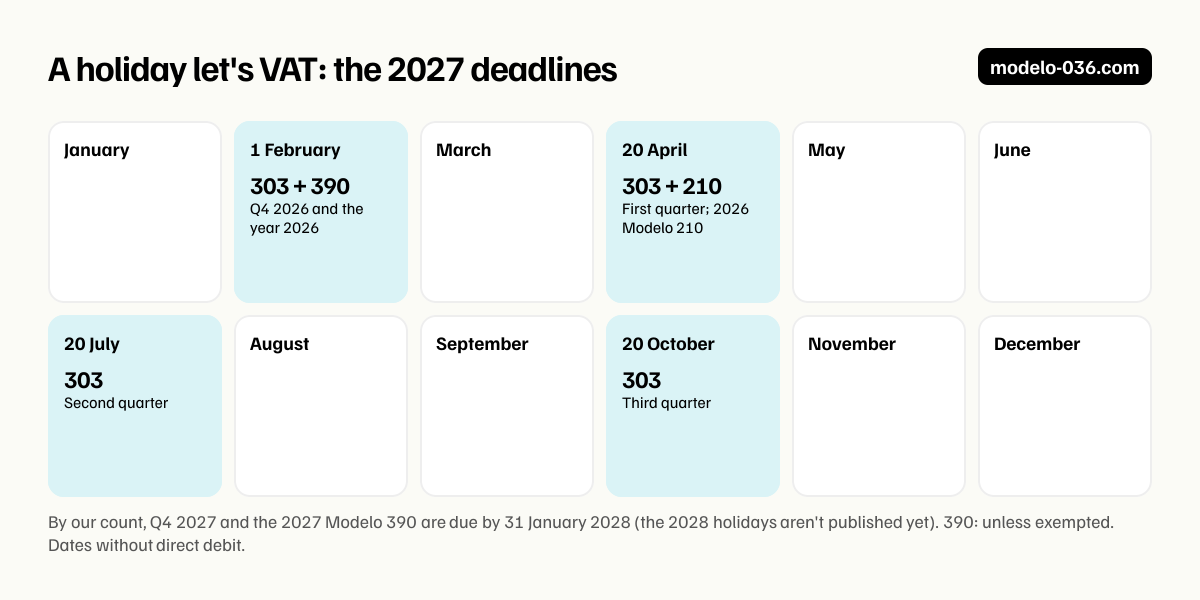
VAT applies from 1 December 2026: the first 303 covers the fourth quarter and is due with the yearly summary. Each date checked against its weekday.
| Return | Period | Last day |
|---|---|---|
| 303 · Q4 2026 | October to December 2026 | By direct debit, until 27 January 30 January 2027 is a Saturday: the deadline moves to Monday. |
| 390 · 2026 summary | 2026 | Unless exempted (still unsettled for holiday lets). |
| 303 · Q1 2027 | January to March | By direct debit, until 15 April |
| 210 · 2026 rents | Non-residents, with tax to pay: 2026 rents grouped, or Q4 2026 rents declared separately | New deadline under Orden HAC/623/2026. |
| 303 · Q2 2027 | April to June | By direct debit, until 15 July |
| 303 · Q3 2027 | July to September | By direct debit, until 15 October |
| 303 · Q4 2027 and 390 | October to December, and 2027 | By direct debit, until 26 January 30 January 2028 is a Sunday. |
Deadlines from the VAT Regulation (article 71.4) and Orden EHA/3111/2009 (the 390); by direct debit, those of Orden EHA/1658/2009, which move by as many days as the filing deadline. Dates worked out by us, day by day, with the 2027 holidays published in the BOE: the Agencia Tributaria's 2027 taxpayer's calendar wasn't out on 12 November 2026. A local holiday can add a day; the 2028 holidays aren't published yet.
Once registered for VAT, you file the 303 every quarter, even with nothing to declare: with no transactions and no deductible VAT, you tick «Sin actividad» (no activity).
If you live outside Spain, your Modelo 210 has its own deadlines: get them in your calendar with CasitaTax's deadline calendar.
Sources: Reglamento del IVA, art. 71 · Orden EHA/3111/2009 (modelo 390), arts. 1 y 8 · Orden EHA/1658/2009 (domiciliación) · Fiestas laborales de 2027 (BOE, 13 de octubre de 2026) · Orden HAC/623/2026 (modelo 210) · Reglamento del IRPF, arts. 70, 108, 109 y 111 · Real Decreto 1065/2007, arts. 31 a 33 (modelo 347) · Agencia Tributaria, IVA en el arrendamiento: declaraciones (regla anterior al 1/12/2026 para apartamentos turísticos)
Penalties: filing the 036 late, or not at all
Not filing the 036 on time is a minor offence with a fixed fine of €400, cut to €200 if you file late of your own accord, before any request from the tax agency. An incomplete, inaccurate or false 036 costs €250. Late VAT returns carry their own surcharges.
| What happens | Consequence | Article |
|---|---|---|
| 036 not filed on time | €400 fine | 198.1 LGT |
| 036 filed late, before any request | €200 fine (half) | 198.2 LGT |
| 036 incomplete, inaccurate or false | €250 fine | 199.3 LGT |
| 303 late, before any request, with VAT to pay | Surcharge of 1% plus 1% per full month late; after 12 months, 15% plus late-payment interest | 27.2 LGT |
| 303 late, with nothing to pay | €200 fine, or €100 if filed before any request | 198 LGT |
Common mistakes
- Looking for Modelo 037: it no longer exists.
- Registering after the first payment or the first let subject to VAT.
- Picking an IAE code that doesn't match the activity: the Agencia Tributaria's activity finder (buscador de actividades) helps.
- Using heading 861.1 for a holiday let: the Dirección General de Tributos puts it in group 685.
- Forgetting the ROI when a business in another EU country invoices you a service without VAT, under the reverse charge.
- Missing the one-month window to report a change of address.
- Only one co-owner registering when the home is let jointly.
Sources: Ley General Tributaria, art. 198 · Ley General Tributaria, art. 199 · Ley General Tributaria, art. 27 · Ley General Tributaria, art. 188
Modelo 036: frequently asked questions
The questions that come up most, with short answers. For your own case, write to us.
Have it filed for meWhat is Modelo 036 in English?

It's Spain's census declaration (declaración censal): the form you file with the Agencia Tributaria to register as a business or professional, report changes in your details and deregister when you stop.
Does Modelo 037 still exist?
No. Orden HAC/1526/2024 abolished it from 3 February 2025. Individuals living in Spain can use the simplified version built into the 036.
When do I have to file Modelo 036?
Register before you start; a company, before its first transaction and at the latest within a month of being set up. Report changes and deregister within one month, counted from the day after the event.
Where do I download Modelo 036 as a PDF?
There is no blank form. On the Sede electrónica, «Cumplimentación, validación y obtención en PDF para su impresión» produces a PDF you hand in at a tax office, or send there by registered post, within one month.
Can I file Modelo 036 online without a digital certificate?
Yes, with Cl@ve as an individual. Without any electronic ID, you can print the PDF and hand it in at a tax office or send it by registered post, or have it filed by an authorised filer or a person you've empowered.
Can I file Modelo 036 without being autónomo with Social Security?
Yes. The 036 is a tax registration with the Agencia Tributaria; joining the RETA is a separate procedure with Social Security (the Tesorería General de la Seguridad Social). Companies, withholders and owners letting with VAT file the 036 on its own.
How do I get a copy of my Modelo 036 or a census certificate for my bank?
Your copy is the receipt you got when filing, and you can download it again under «Modelo 036. Consulta de declaraciones presentadas» on the Sede electrónica. As proof of registration, download the census certificate (certificado de situación censal) on the Sede with a digital certificate, electronic ID card or Cl@ve.
Do I need an NIE to file Modelo 036?
Not necessarily. A foreign individual's Spanish tax number is normally their NIE; without one, you ask for a tax number on the 036 itself, ticking box 110, on paper. A foreign company requests its tax number with the 036.
Do I have to file Modelo 036 every year?
No. You file it once to register, then only when something changes, and when you stop. The periodic returns, such as Modelo 303, are separate forms.
Do holiday-let owners need to file Modelo 036 from December 2026?
Yes, if from 1 December 2026 they let a furnished home to the same guest for 30 nights or fewer and it isn't their main home, or let it with hotel-type services (those lets already paid VAT): the let pays 10% VAT and they must register before the first taxable let.
Can a non-resident owner file Modelo 036 from abroad?
Yes: online, with an electronic ID or through an authorised filer, or on paper, always using the full 036. Owners living outside the EU (except Norway) also need a tax representative domiciled in Spain for VAT.
What happens if I file Modelo 036 late?
Not filing on time is fined €400, reduced to €200 if you file late of your own accord, before the tax agency asks.
Modelo 036 glossary: the Spanish terms in English
- Censo de empresarios, profesionales y retenedores
- The Agencia Tributaria's register of businesses, professionals and those who withhold tax on payments; part of the general taxpayer census.
- Declaración censal
- Census declaration: reporting a registration, change or deregistration to a tax census. The Modelo 036, or the 030 without an activity.
- Alta, modificación y baja
- Registration, change, deregistration: the three reasons for filing a 036.
- Epígrafe del IAE
- The activity's code in the tariffs of the business activities tax (IAE), declared on page 4 of the 036.
- Domicilio fiscal
- Tax address: for an individual, where they habitually live.
- ROI
- Registro de operadores intracomunitarios: the intra-EU operators register, which gives the VAT number (with the ES prefix) used with EU businesses.
- Sede electrónica
- The Agencia Tributaria's online office, where the 036 is filed.
- Censos WEB
- The Agencia Tributaria's guided service for individuals resident in Spain to file a first registration, a deregistration or a change of address.
- Cl@ve
- The Spanish public administrations' electronic ID system, an alternative to a digital certificate or electronic ID card.
- Representante fiscal
- A tax representative domiciled in Spain, required for VAT from businesses established outside the EU (except Norway).
Rather have it filed for you?
Tell us about your case: your request goes to our partner CasitaTax, who will contact you to explain how to file your 036 and what comes after. No obligation.
Our partner
CasitaTax looks after the Spanish homes of people who live abroad. It files your Modelo 036 in your name and, with its holiday-let VAT plan, every Modelo 303 and the yearly summary, paying the VAT for you.
CasitaTax's holiday-let VAT planData protection: the essentials
- Controller
- ONBOARDING, S.L. (sociedad unipersonal, a single-member company)
- Purpose
- passing your request to CasitaTax so that it contacts you.
- Legal basis
- your consent (art. 6(1)(a) GDPR), which you can withdraw at any time.
- Recipients
- ZAHARD LTD (CasitaTax), in the United Kingdom, covered by a European Commission adequacy decision; our processors.
- Your rights
- access, rectification, erasure, objection, restriction and portability, at contacto@modelo-036.com.
- More
- in the privacy policy.